More setup room
A wider aisle provides additional room to establish the correct angle before backing or pulling into a space.
Benefit: Fewer rushed corrections while positioning a large vehicle.

Designed for easier maneuvering
The parking space is only part of the experience. The aisle and approach determine how comfortably a large RV, trailer or boat can be positioned and retrieved.
Parking geometry affects every visit
RV owners often compare price, space length and security first. Drive-aisle width, turning room and the approach to a parking space also influence how easy the facility is to use.
A wide aisle gives a driver more room to position a motorhome, travel trailer, fifth wheel or boat trailer before entering or leaving a space.
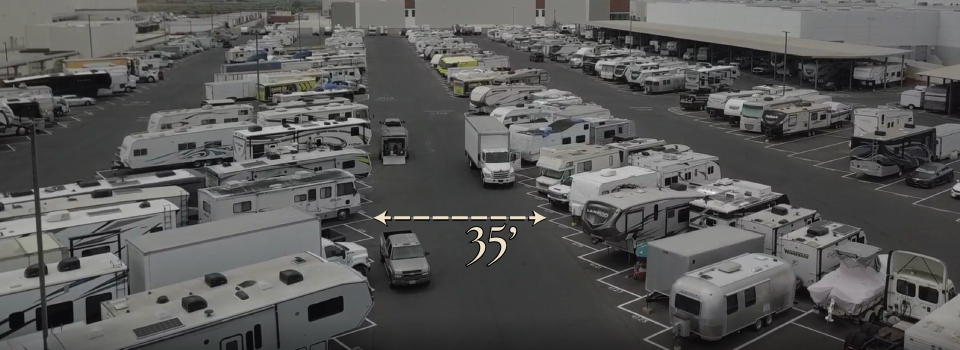
Why aisle width matters
The parking process begins in the aisle. The driver needs enough room to approach, turn and align the vehicle with the selected space.
A wider aisle provides additional room to establish the correct angle before backing or pulling into a space.
Benefit: Fewer rushed corrections while positioning a large vehicle.
Additional working room can make it easier to use mirrors, cameras and a spotter while watching the vehicle's path.
Benefit: More opportunity to check clearances during the maneuver.
If the first approach is not aligned, aisle space gives the driver room to pull forward and try again.
Benefit: A less stressful process when the first angle is not perfect.
Parking design matters when leaving too. The vehicle needs room to exit the space and transition into the aisle.
Benefit: A smoother start when it is time to travel.
Look beyond the number
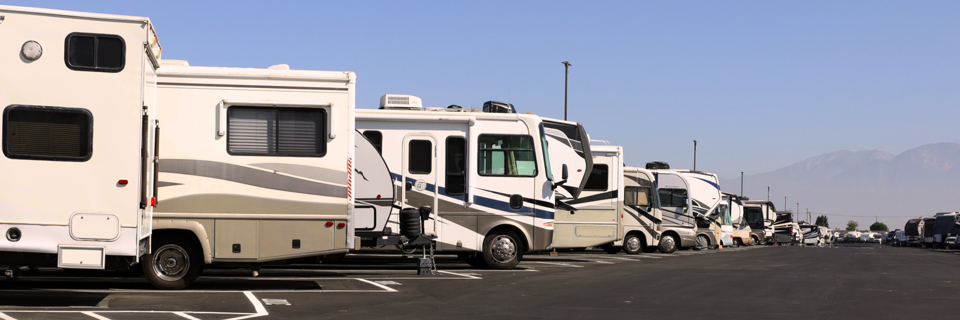
A customer should also look at the complete path from the entrance to the space. The selected space's angle, length, neighboring vehicles, end-of-aisle position and pull-through capability can all affect convenience.
What's in it for you?
The best match is not simply a space long enough for the RV. It is a space the customer can use comfortably.
Ask to see the assigned or available location rather than evaluating only a published space size.
The route and approach angle may change how easy the parking maneuver feels.
A pull-through layout may reduce backing, while a well-positioned back-in space may still be easy to use.
Neighboring vehicles, lighting positions and end locations may affect the practical experience.
Some customers place additional value on spaces that require less maneuvering. Pull-through spaces, end-of-aisle locations and other high-demand positions may carry premiums because the location provides a practical convenience.
The aisle is the working area used to approach, align, park and retrieve the vehicle. More working room can make those maneuvers easier.
No. Vehicle size, driver experience, parking angle, neighboring vehicles and the individual space location also matter. Customers should evaluate the complete approach to the actual space.
A pull-through space is approached and exited without using the same backing maneuver required by a traditional back-in space. Availability and configuration vary.
An end location may provide a preferred approach or additional maneuvering convenience. At McBride's, premiums may apply to certain high-demand locations.
Find the right space
Call for current availability, space recommendations and the price range that fits your vehicle.